Posts

Showing posts with the label canon

Canon 1DX Mark III is Sticking to Convention

It looks like my predictions are off as Canon has announced the development of the 1DX Mark III: https://photonicshunkan.blogspot.com/2019/06/prediction-canon-will-put-pellicle.html https://photonicshunkan.blogspot.com/2019/05/the-canon-1dx-ii-successor-will-be.html That's OK—since I originally predicted that the move to a pellicle mirror would take another product cycle after the 1DX Mark III. You have to make predictions bold even when you know there is always going to be a chance of being wrong. I wrote: "I thought it would take another product cycle of the 1D line for this to happen given Canon's conservatism, hence my prediction that it will take another 4-8 years, but it may be happening sooner than thought. It might even materialise before the 2020 Olympics." There were false rumours about the Mark III having an extraordinarily fast frame rate, which were little more than rumours, and which made me hope that Canon would ditch its conservatism and mo...


PREDICTION: Canon Will Put a Pellicle Mirror into 1D & 7D Successors

Image
I have said it before, and I am reiterating it yet again. Canon has no choice but to reintroduce the pellicle mirror into the EF mount DSLR line of cameras: https://photonicshunkan.blogspot.com/2019/05/prediction-canon-will-reintroduce.html The key factor is that there are too many EF mount users to be able to expect them to dump this mount for mirrorless EVF cameras . The only way to modernise the EF mount line is by reintroducing the pellicle mirror. This will give the camera live exposure preview along with all the other features that are drawing users to mirrorless EVF cameras. Canon will probably introduce IBIS along with eye detect AF because the Nikon D6 is going to get IBIS just like the mirrorless Z mount bodies have already got it (once Nikon adopts a feature Canon follows suit). There is a rumour that Canon is ending its 7D lineage of cameras . I predict that at the same time that the 1D line is upgraded to a pellicle mirror model, the 7D line will also be upgraded to...

PREDICTION: The Canon 1DX II Successor Will be a Pellicle Mirror Global Shutter Camera

Image
The latest news is that a Canon ambassador has been found talking about an upcoming camera that can shoot at 30fps: https://www.canonrumors.com/a-new-canon-dslr-seems-to-be-getting-teased-on-social-media-by-a-canon-ambassador/ People are commenting that the camera must be designed to shoot at 30fps in the mirror up position, which is totally absurd. That is like saying that the mirror is a redundant piece of equipment that needs to be locked up and forced to get out of the way for the camera to function properly. It is much more likely that the 1DX Mark II successor will have no mechanical reflex mirror but that it will instead have a pellicle mirror. That way, the mirror does not need to be moved out of the way for it to function and contributes positively to the accuracy of the autofocus. Some may wonder if Canon has found a way to get the reflex mirror to move fast enough to achieve a 30fps frame rate, but that is unlikely. At some point, Canon have NO CHOICE but to elim...

PREDICTION: Canon Will Reintroduce the Pellicle Mirror to their DSLR System

Image
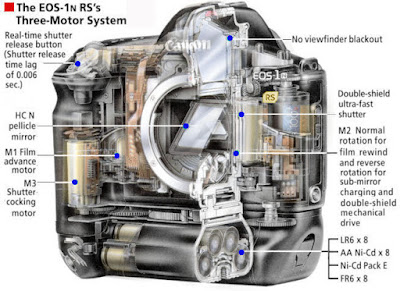
This is a bold prediction, but Canon (and Nikon) will reintroduce the pellicle mirror into their DSLR line camera systems some time within the next 4-8 years. The last pellicle mirror camera released by Canon was the EOS-1N RS introduced in 1995 and only discontinued in 2001: A semi-translucent pellicle mirror replaces a moving reflex mirror that lifts up to capture the image. The key prediction being made here today is that the pellicle mirror will return to a 1D equivalent camera some time in the next 4-8 years. Nikon, in the more distant past, has also had pellicle mirror film cameras like the Nikon F2H from 1976, and they too will introduce a pellicle mirror digital single-lens translucent mirror (DSLT) camera with an electronic viewfinder (EVF) replacing an optical viewfinder. Canon tends to be more conservative than Nikon but in this instance Canon appears to own recent patents relevant to pellicle mirror cameras, whereas no DSLT relevant Nikon patents have be...

What Does "Full Frame" Mean?

Image
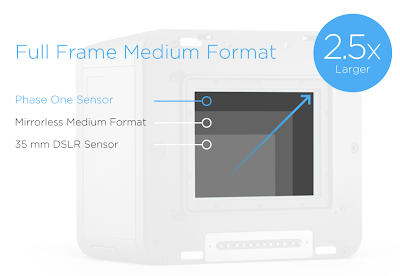
This comes from the Phase One website: Notice that Phase One refer to a digital 645 format equivalent sensor as "full frame". That is probably correct given that the largest format used in standard civilian photography is a 645 format sensor. In addition to the 645 (53.7 × 40.2mm; similar to the 56 × 42mm imaging frame size of 645 format film) and 4433 (43.8 × 32.9mm) format medium format sensor, some video cameras use sensors larger than 35mm (36 × 24mm) format e.g. 54.12 × 25.59mm Arri sensor. There is also the Leica S system with its 45 × 30mm format sensor. That means there are several sensor size formats larger than 35mm format making it increasingly difficult to hail something running in fifth place the leader in the size stakes. Newer video camera sensor formats are now growing larger than 35mm format It is probably only a matter of time before even larger digital photography 670 format sensors go into production though that may not happen for another 6-12...

Sony's FE Mount Fatal Mistake Drags On

Image
My rather notorious piece critiquing the Sony 35mm format E mount mirrorless system written for Petapixel (from April 2016): https://petapixel.com/2016/04/04/sonys-full-frame-pro-mirrorless-fatal-mistake/ A lot of new information has come to light since especially now that Canon, Nikon, and Panasonic have announced their own 35mm format mirrorless systems. First and foremost there is this presentation by Canon at the time the R mount system was announced: https://dc.watch.impress.co.jp/docs/news/1158578.html The diagram I draw your attention to from Canon's media presentation on the new mirrorless R mount is this: It turns out that based on Canon's optical research that the problem with an 35mm format mount with APS-C mount dimensions isn't just a short flange distance but when this is combined with a narrow mount diameter. Note the way light is forced to diffract awkwardly into the sensor corners. It is surmountable but it also means you need a large len...